Passport and Visa Photo Sizes by Country
Passport photo sizes look like a mess of numbers until you realize almost every country uses one of two standards, plus a rule for how tall the head sits inside the frame. Get the outer size and the head height right and the photo passes. This guide gives the dimensions for the common countries in both millimeters and inches, explains the two standards they come from, and points out the head-height trap that fails photos which are otherwise the correct size.
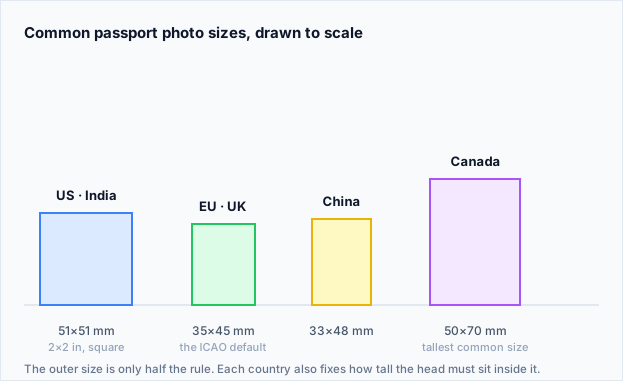
The Common Sizes
| Country | Size (mm) | Size (in) | Head height | Background |
|---|---|---|---|---|
| United States | 51 × 51 | 2 × 2 | 1 to 1 3/8 in (25 to 35 mm) | Plain white or off-white |
| EU / Schengen | 35 × 45 | 1.38 × 1.77 | 32 to 36 mm | Plain light grey or white |
| United Kingdom | 35 × 45 | 1.38 × 1.77 | 29 to 34 mm | Plain light grey or cream |
| India | 51 × 51 | 2 × 2 | About 25 to 35 mm | Plain white |
| China | 33 × 48 | 1.30 × 1.89 | 28 to 33 mm | Plain white |
| Canada | 50 × 70 | 1.97 × 2.76 | 31 to 36 mm | Plain white or light |
| Australia | 35 × 45 | 1.38 × 1.77 | 32 to 36 mm | Plain light grey or white |
| Japan | 35 × 45 | 1.38 × 1.77 | 34 mm (±2) | Plain white or light |
Values are the current published requirements at the time of writing and are occasionally updated by each authority, so confirm against the official page for anything important. The pattern, though, is stable: 35 by 45 mm dominates, the US and India use a 2 by 2 inch square, China is slightly narrower and shorter, and Canada is notably taller.
The Two Standards Behind the Numbers
The 35 by 45 mm format is the ICAO standard, the international specification for machine-readable travel documents, which is why most of the world lands on it. The 2 by 2 inch square is the US standard, followed by a handful of countries including India. If you know which of the two your destination uses, you are most of the way there, and the head-height range is the remaining detail. A single well-composed shot can be cropped to either standard, which is why it is worth shooting loosely and cropping to the specific target rather than trying to frame the exact size in-camera.
Head Height Is the Hidden Variable
Two photos can be exactly 35 by 45 mm and one still fails, because the head is a different size inside the frame. This is the rule most size tables bury, and it is where a correctly-sized photo gets rejected. The US wants the head at 1 to 1 3/8 inches, the EU wants 32 to 36 mm, the UK is slightly smaller at 29 to 34 mm. The practical consequence is that you cannot reuse a US photo for a UK application by trimming the border, because the head will sit too tall. Crop each photo to the specific country target, head height included.
Pick your country and the tool crops to that exact size with the head at the correct height. No measuring by hand.
Crop to My Country SizeFrequently Asked Questions
What is the most common passport photo size?
35 by 45 mm, the ICAO standard used across the EU, the UK, Australia, Japan, and most of the world. The main exceptions are the US and India, which use a 2 by 2 inch (51 by 51 mm) square.
Is the US passport photo size really 2 by 2 inches?
Yes, 2 by 2 inches (51 by 51 mm), a square, with the head between 1 and 1 3/8 inches from chin to crown. This is different from the 35 by 45 mm rectangle used by most other countries.
Can I use the same photo for two different countries?
Only if they share the same size and head-height rules. A single high-resolution shot can be cropped to different targets, but you must re-crop for each country rather than trim one print, because the head-height requirement differs even between countries that share the 35 by 45 mm size.
Why does head height matter if the photo is the right size?
Because border systems measure the face, not the border. A photo can be exactly 35 by 45 mm and still fail if the head is too tall or too small inside it. Match the head-height range for your specific country, not just the outer dimensions.