Passport Photo Requirements: Size, Background, Rules
Most passport photos are rejected for one of a handful of reasons, and none of them are about how you look. They are about geometry and lighting: the head is the wrong size in the frame, the background is not plain, there is a shadow behind the ear, or the eyes are half closed. This guide lists every rule that a reviewer actually checks, explains what each one means in plain terms, and tells you how to meet it without a studio. The specifics here follow the ICAO standard that most countries base their rules on, with the two big exceptions (the United States and a few others) called out where they differ.
The Rules Almost Every Rejection Comes Down To
A passport photo has to be machine-readable as much as human-readable, because border systems compare it against a live camera. That is why the rules are so strict about head size and even lighting: the face has to be measurable, not flattering. Here is the full checklist a reviewer works through.
| Rule | What it means | Common reason for rejection |
|---|---|---|
| Head size | Crown to chin fills 50 to 69% of the photo height (about 1 inch / 25 to 35 mm for a US photo) | Face too small because the shot was taken too far back and never cropped in |
| Head position | Centered, facing straight at the camera, eyes level | Head tilted or turned, chin up or down |
| Background | Plain white or very light grey, no texture or objects | A wall with a visible shadow, a colored wall, a door frame in shot |
| Expression | Neutral, mouth closed, both eyes open | Smiling, raised eyebrows, squinting |
| Lighting | Even light across the face, no shadows on the face or behind the head | Shadow to one side from a single overhead lamp |
| Eyes | Open, visible, looking at the lens, no red-eye | Hair across an eye, glare on glasses |
| Glasses | Increasingly not allowed at all; if worn, no glare and eyes fully visible | Reflection hiding the eyes; many countries now require them off |
| Head coverings | None, except worn daily for religious reasons, and then the full face must show | A hat, or a scarf shadowing the face |
| Recency | Taken within the last 6 months and a true likeness | An old photo that no longer matches you |
Size and Head Height
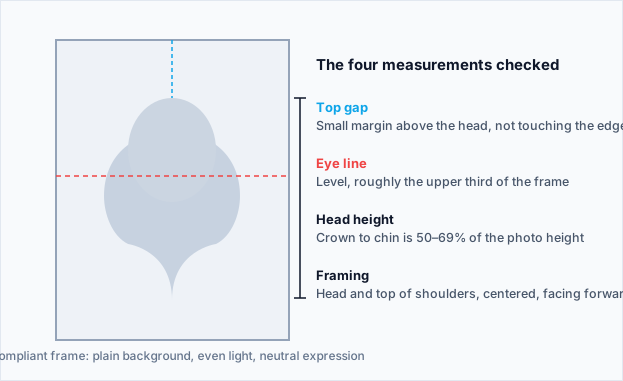
The outer photo size and the head height inside it are two separate rules, and the head height is the one people miss. A US photo is 2 by 2 inches with the head between 1 and 1 3/8 inches from chin to crown. Most other countries use 35 by 45 mm with the head between 32 and 36 mm. If you stand back to fit your shoulders in and never crop, the head ends up far too small, which is the single most common measurement failure. Frame loosely when you shoot so you have room to crop, then crop to put the head at the right height.
Sizes and head-height ranges vary by country. The full table, drawn to scale, is in the sizes guide.
Photo Sizes by CountryBackground
Plain and light is the whole rule, and it is stricter than it sounds. White or very light grey, with no pattern, no gradient, and nothing behind you. The trap is not the wall color, it is the shadow you cast on it. Standing right against a white wall throws a hard shadow around your head that reads as a dark edge, and that alone fails the photo. Stand about half a meter in front of the wall so any shadow falls low and out of frame, and use soft light rather than a single hard lamp.
Expression, Eyes, and Glasses
Neutral expression means mouth closed and no smile, because a smile changes the shape of the face the border camera has to match. Both eyes open and looking straight at the lens. Glasses are the fastest-changing rule: the US, the UK, and a growing list of countries now require you to take them off entirely, and where they are still allowed there must be no glare and no frame covering any part of the eye. If your prescription lets you manage without them for one photo, take them off and remove the question.
Lighting and Shadows
Half of all rejections are really lighting problems wearing another label. A single overhead light or a phone flash puts a shadow under the nose and to one side of the face, and a wall-hugging pose puts one behind the head. The fix is soft, even light from the front. Daylight from a window off to one side, with you facing the window, is the easiest source that works. Avoid direct flash, avoid a light directly overhead, and give the wall enough distance that nothing lands on it.
Digital or Printed
Online applications want a digital file, usually JPEG, above a minimum pixel size (600 by 600 for the US, often 900 by 1200 for a 35 by 45 mm photo) and under a maximum file size. In-person and mail applications want prints on photo paper at the exact physical dimensions. The same well-composed shot serves both: you crop it to the right proportions once, then export a digital copy and print a copy. What you cannot do is stretch a too-small photo up to the pixel minimum, because the reviewer sees the softness.
Upload a photo and get it cropped to your country size with the background and head height checked, free and in the browser.
Make a Passport PhotoFrequently Asked Questions
Can I smile in a passport photo?
No. A neutral expression with the mouth closed is required almost everywhere, because a smile changes the facial geometry that border systems match against. A natural, relaxed face is fine, but no smile and no raised eyebrows.
Can I wear glasses?
Increasingly not. The US, the UK, and many other countries now require glasses off. Where they are still permitted, there must be no glare on the lenses and the frames must not cover any part of the eyes. Taking them off for the one photo is the safe choice.
What background color is required?
Plain white or very light grey, with no pattern, objects, or other people. The most common background failure is not the color but a shadow cast on the wall, so stand away from it and light yourself evenly.
How big should my head be in the photo?
Between 50 and 69% of the photo height, crown to chin. For a US 2 by 2 inch photo that is 1 to 1 3/8 inches; for a 35 by 45 mm photo it is about 32 to 36 mm. Too small is the most common measurement rejection, so crop in after shooting.
How recent does the photo have to be?
Within the last six months, and it must be a true current likeness. If your appearance has changed noticeably (a beard, very different hair), use a new photo even if an older one is technically within the window.